Based on Erayak Power’s published specs, choosing a power inverter starts with matching continuous wattage to your devices. Surge capacity matters for startup loads, and monitoring features like LCD display help track battery level and output. Erayak offers options from 150W to 3000W continuous for various uses.
Choosing a power inverter depends on your device power needs and where you plan to use it. Erayak Power’s TANK series inverters convert 12V DC battery power into 115V or 120V AC output with continuous ratings from 150W to 3000W, as stated in their product descriptions.
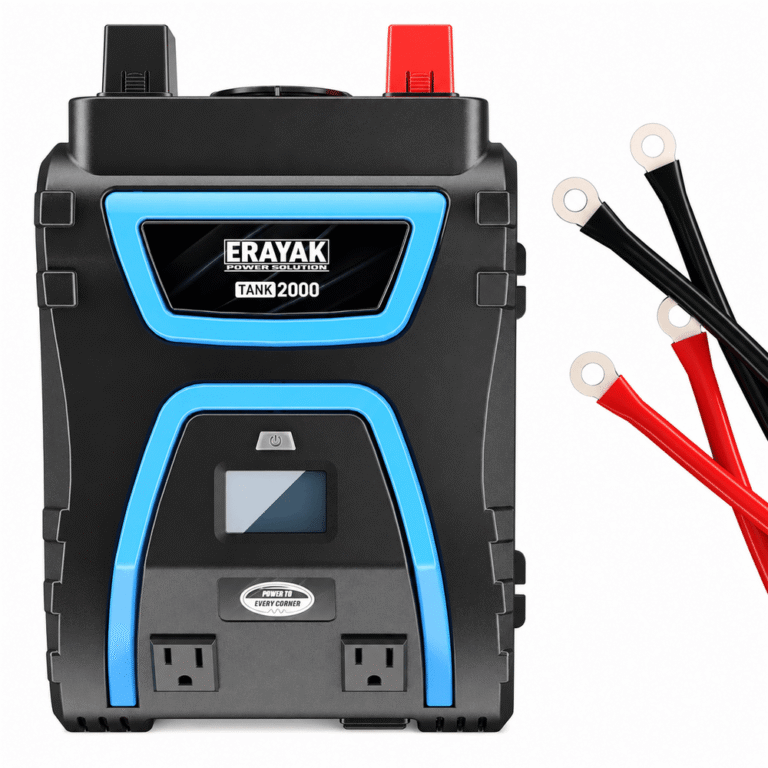
For example, the TANK2000 delivers 2000W continuous power with 4000W surge, while the TANK1000 offers 1000W continuous power with 2000W surge. All models with LCD display let you monitor battery level, output power, and fault messages. Consider the ports you need: AC outlets, USB-A, and USB-C.
Who This Guide Is For
This guide is for anyone looking to convert 12V DC battery power into AC power for RV, truck, car, solar, or home backup applications. Erayak Power’s inverters are designed for these uses according to their product listings. Whether you need a compact 150W unit for car travel or a 3000W unit for heavy-duty equipment, the criteria below will help you match your needs to the published specs.
Key Criteria for Choosing a Power Inverter
- Continuous Power (Watts): The steady power the inverter can supply. Erayak offers models from 150W (TANK150) up to 3000W (TANK3000).
- Surge Power (Peak Watts): Temporary power for starting motors or devices. For example, the TANK3000 provides 6000W surge, and the TANK1000 provides 2000W surge.
- Wave Type: All Erayak inverters listed use modified sine wave output, suitable for many electronics but not all sensitive devices.
- Input Voltage: All models use 12V DC battery input (vehicle or deep-cycle).
- Output Voltage: 115V AC or 120V AC depending on the model.
- Outlets & Ports: Number of AC outlets, USB-A, and USB-C ports vary. The TANK400 has dual AC outlets and USB-C; the TANK150 has three AC outlets plus an extra 12V socket.
- Monitoring: LCD display on many models shows battery level, output power, input voltage, and fault messages.
- Remote Control: Some models (TANK1000, TANK2000, TANK3000) include remote on/off control.
- Weight & Portability: Range from 1.2 lb (TANK400) to 7.2 lb (TANK3000).
- Fuses: The TANK2000 includes 6.40A fuses.
Common Mistakes When Choosing a Power Inverter
- Underestimating surge power: Devices like refrigerators or pumps may draw 2-3x their running wattage on startup. Erayak’s TANK3000 offers 6000W surge, while the TANK1000 offers 2000W surge.
- Ignoring total continuous load: Add up all devices you plan to run simultaneously. A 2000W inverter cannot power 2500W of continuous load.
- Assuming pure sine wave output: Erayak’s TANK series uses modified sine wave. Some sensitive electronics (e.g., certain sensitive electronics) may require pure sine wave, which is not stated as available.
- Not monitoring battery voltage: The LCD display on many models helps you avoid deep discharging your battery.
- Forgetting connection type: Some models connect via battery terminals (e.g., TANK3000 includes a 110V direct-connect terminal), while others plug into a cigarette lighter (e.g., TANK200, TANK150).
Questions to Ask the Brand Before Buying
- What is the warranty period? Erayak Power’s warranty policy is not stated in the provided data.
- Which models are eligible for return? The return policy states some items may not be returnable; check the product listing for specific exclusions.
- What is the estimated delivery time for my location? Shipping times are shown at checkout but are not promises.
- Are the inverters compatible with solar charge controllers? The product tags include ‘solar’, but compatibility details are not specified by the brand.
- What is the recommended battery capacity for each inverter? This is not stated in the available product descriptions.
Examples from Erayak Power's Data
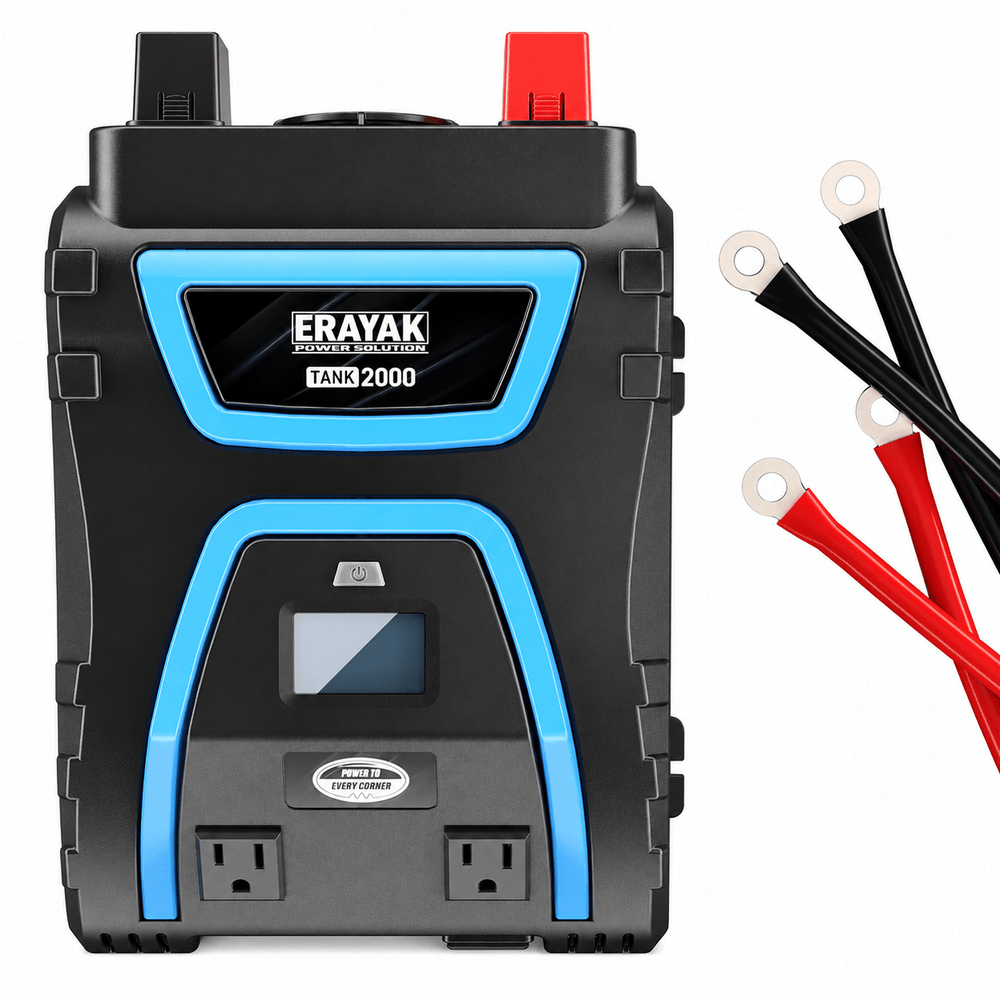
erayak-2000w-power-inverter-12v-dc-to-115v-ac-lcd-display-modified-sine-wave-remote-control-usb-a-type-c-ports-6-40a-fuses-quiet-fan-for-rv-truck-solar-home-backup (TANK2000): 2000W continuous / 4000W surge, 12V input, 115V output, LCD display, remote control, USB-A and USB-C ports, 6.40A fuses, 6.2 lb.
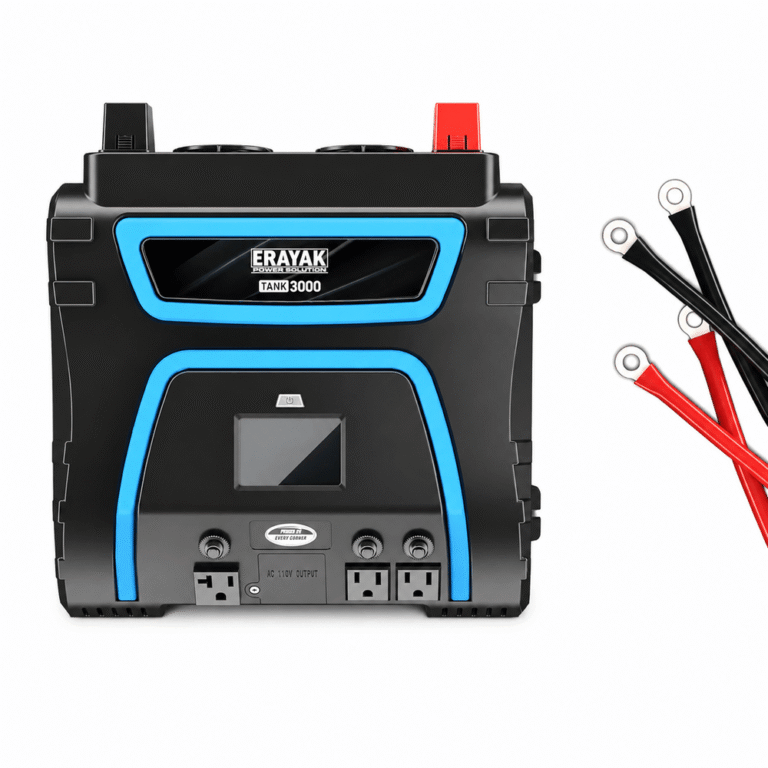
erayak-3000w-power-inverter-12v-dc-to-120v-ac-lcd-display-modified-sine-wave-remote-control-direct-connect-terminal-for-rv-truck-solar-system-home-backup (TANK3000): 3000W continuous / 6000W surge, 12V input, 115V output, LCD display, remote control, 110V direct-connect terminal, 7.2 lb.
erayak-1000w-power-inverter-12v-dc-to-110v-ac-lcd-display-modified-sine-wave-dual-120v-ac-outlets-usb-a-type-c-ports-quiet-fan-for-rv-truck-car-home-backup (TANK1000): 1000W continuous / 2000W surge, 12V input, 115V output, LCD display, dual AC outlets, USB-A and USB-C, 2.1 lb.
erayak-400w-power-inverter-car-charger (TANK400): 400W continuous / 800W peak, 12V DC input, 120V AC output, dual AC outlets, two USB-A and one 18W USB-C port, 1.2 lb.
Checklist Before You Order
- ✔ Determine total continuous wattage of all devices you plan to power.
- ✔ Check surge requirements for any motor-driven equipment.
- ✔ Confirm output voltage matches your region (115V or 120V as noted on the model).
- ✔ Count needed AC outlets and USB ports (USB-A, USB-C).
- ✔ Verify input connection type: battery terminal (TANK2000/3000) or cigarette lighter (TANK150/200/400).
- ✔ Consider weight and size if you need portability (range 1.2–7.2 lb).
- ✔ Review the return policy: 30-day return window with free return shipping, items must be unused with tags and original packaging where applicable.
- ✔ Check shipping costs and estimated delivery times at checkout.
Frequently asked questions
What is the difference between continuous power and surge power?
Continuous power is the steady wattage the inverter can supply indefinitely. Surge power is the temporary boost needed to start motors or devices. For example, the Erayak TANK2000 provides 2000W continuous and 4000W surge. Surge typically lasts a few seconds.
Can I use an Erayak power inverter for solar systems?
Some Erayak inverters are tagged for solar use (e.g., TANK2000 and TANK3000). However, compatibility with specific solar charge controllers is not detailed in the available data. You should verify system requirements directly with the brand.
What is the return policy for Erayak inverters?
Erayak accepts returns within 30 days of delivery, with free return shipping and a provided label. Items must be unused, in original packaging, and with tags. Some items may be non-returnable, so check the product listing. Start a return by logging into your account.
Does Erayak offer a warranty on its inverters?
Erayak Power’s warranty policy is not stated in the available data. You should contact the brand directly to confirm warranty terms before purchasing.
Do these inverters work with car cigarette lighter sockets?
Smaller models like the TANK150, TANK200, and TANK400 plug into a 12V vehicle socket. Larger models like the TANK1000, TANK2000, and TANK3000 require direct battery terminal connections.